What you are able to do as a single human being is shifting entirely. The skills that we should prioritize learning are also shifting entirely.
These days, I’m a doctor still working in clinics where on one week I’ll do stuff like cut out skin cancers and treat chronic health conditions, and in the other week work on YouTube channels. I guess some people know me for YouTube storytelling.
But, being busy, I have a gluttony for productivity. So I’m also someone who‘s ended up using AI agents a ridiculous amount.Maybe not compared to Twitter people, who are a different species of human, but…
For some context: I‘ve got two different machines running OpenClaw (Clawdbot) and am about to buy a third, for parallelism reasons. I’ve also been prototyping making an AI town, for multi-agent orchestration.
I also think the idea of the “one-person billion dollar company” is actually kind of cool, and likely achievable. So thinking about the meta of AI agents is something I think is absurdly useful/beneficial, which is why I want to nerd out about it.
There is an increasingly wide gap that is now forming between people that can do a ridiculous amount with AI, and people who don’t.
The reason that this is a matter of urgency is that, to me, it feels similar to the 2021-22 era of YouTube. Basically, if you started studying YouTube storytelling back then, it was fairly straightforward to keep track of changes in the meta. Whilst stories themselves have been around since time immemorial, YouTube-specific storytelling had a lot of specific nuances that were easy to observe if you looked closely enough. And when you closely observe how YouTubers change over time, you get to develop an intuition that can only happen from observing incremental progress.
So if you start getting really good at AI now, it will pay massive dividends off in the future, and you will be unable to understand things that are very difficult to intuit later.
In particular, there are a few paradigms that are shaping the way that I think about how to use AI in this world. These are actually not AI-specific principles, it's just that they become a lot more accessible thanks to AI.
And, to put it bluntly: anyone who doesn't at least take these into consideration will probably end up falling behind.
This is still a work in progress, but here are three skills that I think are absolutely critical to develop in a world of AI agents.
1. Orchestration as a skill
CEOs of successful companies are very good at guiding a gigantic organic mass of employees into direct economic output.
Using AI agents well is about understanding that an LLM aren't just programs with rules to follow. but similar to this example, are closer to an organism that you guide.
Orchestration requires:
Well-defined visions
The right amount of grip
An understanding of how inputs (prompts that you make) are eventually transformed into outputs
Limitations of both yourself as well as AI agents
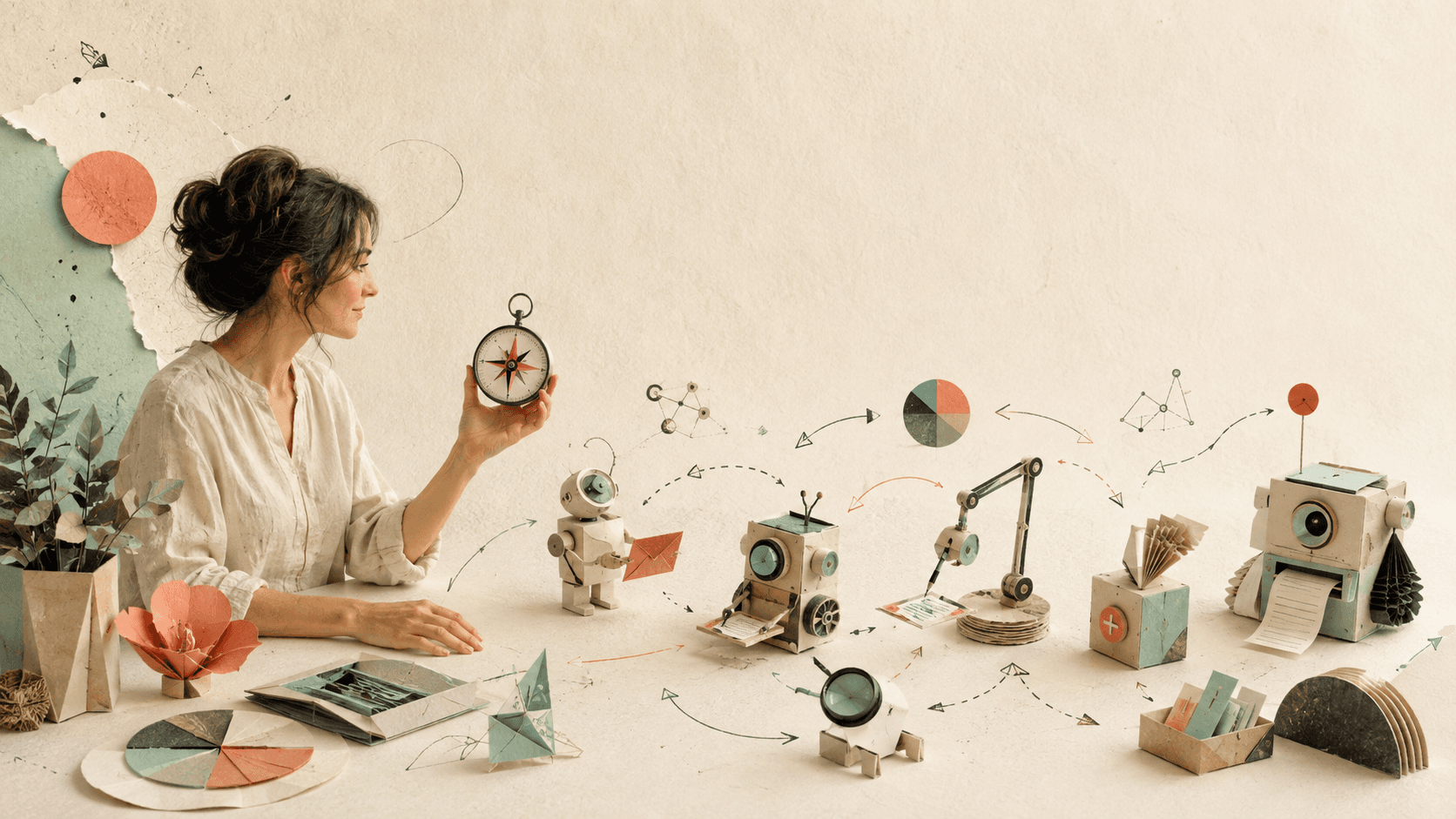
Perhaps most importantly is that orchestration is fundamentally about seeing whatever you're doing as a massive flow chart, where information bounces around and flows, and is transformed as it bumps into different parts of your system.
I also want to emphasise the importance of vision. The thing about AI is that you are able to optimise for any goal that you like. So, it is extraordinarily important to make sure that that goal is actually useful to you.
It's always been the case that the hardest part about anything is not necessarily trying to figure out the right answer, but always to try and figure out the right question to ask in the first place.
2. Parallelism
I think the greatest productivity hack of recent is parallelism. One of the great reasons that AI agents are so useful is the same reason that it is useful to have 1000 employees of a single company: you are able to produce output that is not tied 1:1 to your own time.
This is a skill that I'm personally learning a lot about, as it turns out that keeping track of many things going on at once is actually very difficult. As a doctor, even if I have to multitask, ultimately a piece of paper and a pen is enough to keep track of even 30 patients. But it's because each of those patients has a logical trajectory towards a "best" outcome, and the tasks required to get them there (such as investigations or treatment) are also incremental and logical.
But if an AI agent does work, how do you keep track of something which has already taken 50 steps practically? It is very difficult to, for example, have the knowledge of exactly what happened at step 27 because you're being presented the outcome of 50 steps at once, and this might be across something like 7 agents, for example. There may be something that goes terribly wrong at step 32, that ends up being a security risk or just plain silly.
And perhaps most confusingly: when you come to do the most important task of being a human-in-the-loop — verification of outputs — then you might say that your AI has performed wrongly somehow, but it is not clear at all why it's performed poorly.
Thinking about it in a more simple way, it's like you're trying to follow along a storyline, except that there are 20-minute gaps between which part of the story you are presented, and your brain just has to make a whole bunch of assumptions about what happened between those gaps.
Parallelism is one of the most powerful features of using AI agents, because it means that you can literally perform 1000 to 10000 times the amount of work that you might usually accomplish as a single human, but your ability to do that actually depends on how good you are at managing multiple tracks of productive output at once.
I do not think it is possible to be good at that by default. I think CEOs might be very good at it, or people that run big companies and teams already, but this creates an absurdly big weakness that, if not consciously dealt with, will always hinder them from becoming better in a world of AI:
The danger is that there is no need to get good at AI agent parallelism, for people that are already good at human parallelism, and so these kinds of people will never experience enough pain to change.
I believe that this is a skill that is extremely difficult to outsource too, because being good at AI agents means being good at understanding how your entire company (or own productive output) works as a whole.
3. Redefining good work
The CEO of Anthropic recently said something quite smart, which is that fundamentally their business is about demand prediction more than anything else. With good product in places of the right demand, they have created a multi billion dollar business.
The thing about AI is that it is not simply cheap work being created, but good work. This is very concerning for individuals, because learning how to do good work requires bad work to happen first.
The essays we wrote as third graders have no economic value by themselves; we only wrote those because they helped us learn. To articulate something that sounder obvious when said out loud: we have the foresight to know that writing those essays is valuable for learning.
It looks like Bad Work, but we know in fact that it is Good Work. And so we do it.
Developing the connection between that kind of foresight — and what you’re doing with AI now — will be critical.
You can’t just look one step into the future, as many will be tempted to do. Work will be bad before it’s good. It is only after many hours of practice that hitting piano notes turns into actual music.
This all seems a bit airy-fairy, so let me actually try and ground this on a concrete example. Right now, there are four types of people in the world:
people that haven't heard of OpenClaw, which in short is an AI agent on your computer* (I know that’s a simplification)
people that have heard of it, but haven’t tried it
people who have tried it, but couldn’t see the use of it
people who get immense use out of it
Many people can’t cross from 2 to 3. Fair enough, not everyone is comfortable with the terminal, and there’s some intimidating stuff in the onboarding.
But the bridge you have to cross between 3 and 4 is much more interesting.
People who get immense use out of it understand that it is essentially a custom application that you are building, that can process mass amounts of data at once, and is fundamentally something that you have to tie to your vision.
I can guarantee you that most people who are in 4, are people that have sunk at least 50+ hours into either OpenClaw or coding with AI (Claude Code, Codex) in the terminal.
And then all people who got to this stage are just people who were tinkering with small applications that they actually found useful for themselves.
You don't start with gigantic visions for a company and how your entire company can run with AI. You start with small prototypes of stuff that you've always wanted to see enter the world. You come across obstacles and limitations, and then you figure out how to talk to your AI chatbot about how to fix it.
And after you've had experience with this vision-to-implementation cycle on the scale of single apps, you then broaden your perspective and think "so, what if I were to have two of these agents running at once? What if I were to teach them some skills based on things that I'm already doing? How do I actually go about teaching them?"
And then after a whole bunch of questions like that, you end up at concepts like orchestration and parallelism and trying to use AI agents in a way that a CEO might direct employees of his own company.
Conclusion
I myself am building an AI town, which I personally think is the most intuitive UX for coordinating AI agents in parallel.
I’m starting off with building it for the specific use case of vastly increasing the speed of my own YouTube channel workflows, as well as for helping build my YouTube course platform creatorside.io .
If you’re a YouTuber who is interested in using AI agents like this, DM me. I’d love to figure out use cases beyond my own for content creation.
Also, if you’re a healthcare professional who thinks AI agents could be useful to discuss, also feel free to DM. I’m still figuring out stuff here too, and I think it represents something that could be extraordinarily useful for patients. I’m not sure how exactly, so I need to know more of the kinds of people who would read X articles like this.
(Pictured: Peter Steinberger, creator of OpenClaw. I only found out today that this image was only partially real, as he added more screens using Grok. This one image ironically was quite inspiring, despite being a bit of a meme.)